Last weekend the Franklin Land Trust’s annual farm and garden tour provided the excuse to venture up to the top of the hill and visit old Mr. L.’s farm, now renamed Birchmere Farm under the stewardship of young farmer C. C. welcomed us up at the top and chatted while we admired the view, her cows (Jerseys and Jersey-Holstein crosses), the horses and chickens. We bitched companionably about other neighbors and talked about her plans for cheese making, meat selling and other hopes for the farm. We also talked about her seven-year lease, which seems long for a lease on a house but precious short for a farm. And would the spot really escape development long-term? What would the family do? What could we do? Looking over her view, thinking about the wet marshy meadow by the beaver pond in back of the cemetery, started feeling a little desperate.
Spied these bloodroot this morning on my way into the woods, came back in early afternoon sun to see them fully unfurled.
Up at the pond, Petey instituted warm-season weenie-cooling procedures this morning, the earliest date for such mud-lounging ever… climate change, duh!
The hill is alive with the sounds of water moving. Running, rushing, dropping, dripping, oozing. Splashing (Suzy). There’s usually a bunch of water moving downhill right about this moment in the season and after the last two days of torrential rains it is distinctive.
Roaring Brook is roaring.
I feel that our humble home-on-the-hill is blessed by the fact that our basement doesn’t flood. It’s enough to challenge my normally robust gloomy belief that if there’s cwap to be stepped on that I will.
F the Plumber tells me that even in the summer we have 12 something-or-others of pressure at the point the water enters our house from the well. Our 365-foot well is truly artesian, the pressure pushing water out of the ground, overflowing through an overflow valve 12 months a year to keep the well cap from exploding.
What a gift. To live where you want to live and not have to struggle for water. Half the world is trying to catch the drops that fall on their roofs every once in a while or drink vile stuff and we’re letting it run down the hill to keep the well from exploding.
And we are spoiled. Our water tastes better than any other.
In the last month we’ve gotten 6.47 inches of rain, 2.96 inches of it just this last week. Last year the same whole month saw 1.64 inches.
Note Suzy peering over the waterfall at Old Cricket Hill Road... ("her" waterfall.)
L. tells me that Petey and Suzy did see their shadows this morning. Since we haven’t actually located or met any of the Groundhogs of Cricket Hill, the dogs are the nearest things we’ve got to go by. Anyway, six more weeks of …
Unfortunately, the National Climatic Data Center, located in Asheville, North Carolina has bad news about this prediction. Those good folks have evidently made good use of federal tax dollars by studying the accuracy of groundhogs’ predictions for the past 40 years and report only a 39% accuracy rate. So reading about the history of GHD, it seems like it used to mean just a simple Winter Done Yet? Y/N kind of thing but then Christian Europe changed from the Julian calendar to the Gregorian calendar and now even if you make it through the six weeks, winter still isn’t over. (In the old days 6 weeks was the actual calendrical end of winter). I don’t really handle the change-the-calendar thing well, cognitively. I find I have to just take it on faith, sort of like the international date line…
Anyhoo, Groundhogs of Cricket Hill makes me think of one of those fundraising calendars like Hotties of the Hartford Fire Department. Can’t you just see those Marmota monax showing off their little buff furry chests, standing on their hind legs, craning their necks looking for the damn shadows?
My friend W. Pedia tells me the darn things are also known as whistle pigs, an evocative name I’d say. Wiki P. has been kind enough to provide a table of famous groundhogs, 23 of them in all. Memorable names among them: Queen Charlotte, Sir Walter Wally, French Creek Freddie, Wiarton Willie, and Spanish Joe. Which brings us to the unfortunate Mrs G. Some lame PR hack (like me) trying to get some publicity for a Mass. non-profit has spent the last several years promoting their own ground hog (“Mrs. G.”) for adoption by the state legislature as the official state GH. Evidently they haven’t managed to enlist any biotechnology trade groups to lobby for them and the thing hasn’t gotten any traction. What do you expect, going up against the likes of Sir Walter Wally with “Mrs. G.”
This blog’s brief hibernation seems to be over even though things are still pretty quiet out there on the hill. We’ll see; we do that.
(I’ve just reread this post and it sounds like I’m channeling Andy Rooney… scary.)
The hill is blanketed with its protective layer of snow and ice. The sounds are very different, muffled, subtle. Two days ago, Suzy and I went on our morning jaunt without Petey, who briefly tried out the 2-below temperature before disappearing back into the house. Tomorrow the hill will have nine hours, two minutes and fifty-seven seconds of day time, as short as it gets here.
Much has moved into hibernation here and so too goes this blog for now. Back around ground hog’s day.
So it may be the season to give thanks but certainly not if you’re a deer on this hill, unless you’re a suicidal deer. Starting Monday, the hills will be alive with the sounds of guys with loaded guns and cans of Bud.
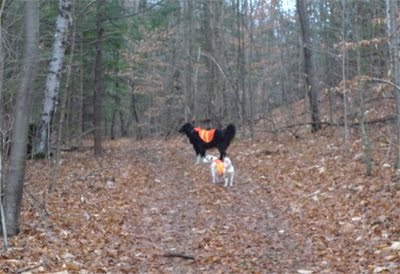
This means that it’s time to pull out the orange mesh vests and see exactly how fat the dogs have gotten since last year. If it’s a year in which the same size vest fits easily over the dog bellies, it’s a year in which our Weight Nazi Veterinarian won’t shake his head ominously when we’re in his examining room.
Breaking out the orange vests is a time of great excitement and celebration for the dog population. (I can tell you after a lifetime of being owned by dogs that Pavlov wasn’t really that smart a guy.) For that matter, Petey and Suzy get pretty excited when L or I put on shoes too, but then it’s an excitement mitigated by the deep dog knowledge that shoes don’t always mean a walk for them. But orange vests always mean just that.
I have nothing against hunting except my own immoderate fear of death for myself and companions. What I do have something against are all the dumped beer cans in the woods. And for gods sake, why are they always Bud? Blowing the heads off innocent cute animals who are just minding their own business, OK, I get that impulse. But if you’re heading out to the woods with weapons, ammo and a lot of alcohol, couldn’t it be something better than Bud?
Sometimes my clinging need to preserve my life while walking in the woods during this season gets me started whistling, even singing (god help us), while on the trails. (This is related to my favorite anti-bear measure, much to the amusement of certain California in-laws, of loudly yelling Go Away Bears! while in the woods.) The whistling/singing during hunting season is based on the fervent hope that the hunters can put two and two together and understand that no self-respecting deer will tolerate that noise and they (the hunters) should all just pick up the six-packs and move off. So far so good.
Gratitude for having this hill to walk on this morning, the last Thursday in November.
Gratitude that the rain of the last three days held off so Suzy and Petey and I could enjoy ourselves out here, early morning ground fog lifting and the leaves wet underfoot. And gratitude that there are a few more days until the advent of deer hunting season when the whole experience of walking on the hill will be spiced up by a little fear of having one’s head blown off.
Roaring Brook filled with rain, rushing down the hill.
This lovely early November Sunday morning full of sun and the promise of a warm day ahead found the dogs and I out for a Pond Loop walk with camera and time and reflective curiosity nipping at the edge of semi-consciousness.
Our friend A, psychiatrist by trade, once explained some of the thinking around seasonal depression, light, the optic nerve, the reduction of light getting in to the brain through the optic nerve, resulting chemical changes. This morning it strikes me that at this moment of the year my whole ability to see suffers the same fate. See with a Capital S in the sense that Paul Rezendes uses it. See as in connect deeply by opening the senses to the forest around me. Maybe it has to do with the reduction in light getting through but it’s as if once things get browner and colder outside that my ability to see gets reduced as well.
These late fall days too often I'm just walking along these trails and I'm caught in my head, not present in the woods much at all. All seems plain and brown and dead or dying.
Until, of course, I open my eyes.
There is so much going on out here so it’s a real pity it’s tough to see. The browns are actually magnificent and there’s an undertone of muted green everywhere with occasional highlights of lively emerald green, strange purple, other shades. The light has a filtered quality that is partly the barer branches it is moving through, partly angle of the season.
Ozro Sherwin Levi Lincoln Lee Submit S. Stebbins Phila Orcutt Capt. Eleazer Frary Elisha Clark Capt. Noah Look
All these names of long-gone residents of Cricket Hill make me jealous: they were really “from” here. (Or so I romantically suppose.) As a ‘native’ of a suburban L.I. town, I’ve had adult-life-long envy of people with roots in places like this one. People in this town who’ve been raised here by parents themselves raised here intimidate me. Recently found myself envying a woman around my age who wasn’t born here but moved here as a child with her family, lived her prior adult life elsewhere but, parents and brother still here, moved back after raising her own family.
In my life, I consider myself “from” a town where my family lived for twelve years. I’ve lived here, on this hill, longer than anywhere else.
All those names in the Cricket Hill cemetery: I am related to many of them. Related by walking over the same ground, related by listening to the quirky chirps of the genetic descendents of the squirrels they heard as they walked to the barn or to the schoolhouse or to the mill. Some of them actually held this place in their hearts – home – I’m sure. I’m not sure I’ll ever feel more than a privileged visitor, a temporary resident with great admiration for the sky as seen from this hill and the sunrises over the valley below. Although in the dark of a warm late October wee-small-hours night, sleeplessly listening to the wind blowing through the dry leaves still on the trees outside the open window, to the accompaniment of Petey’s low-decibel snoring, it felt like this is as close as I’m going to get.
Some months ago I found myself in a sort of little left-behind town in Rensselaer County, New York where several generations of my antecedents lived in the first half of the nineteenth century, walking through the old cemeteries looking for some of the names I’d researched – Crandall, Burdick, Green – and finding some of the surnames though none of the particular individuals I’d hoped for. My antecedents came there from Rhode Island and left for Illinois a couple of generations later. How many generations of residence make it a family’s home? And what did they leave behind when they went that connects me to the place today? Names on gravestones? The plain fact of having been there? Their faith? And, with an eye toward the upcoming day of the dead, a few epitaphs from Cricket Hill cemetery:
Reader you all so shortly Must be stripped of life & turned to dust. (Betsy Adams, died 1803, age 18)
Boast not thyself of to morrow, for thou know est not what a Day will bring forth. (Capt. Abel Dinsmor, died 1803, aged 67)
Death is a debt to nature due Which I have paid and so must you (Ezra Marsh, died 1833, aged 23)
Unshaken as the sacred Hill and firm as Mountains be Firm as a rock the soul shall rest That leans O Lord on thee (Mr. Judah Clark, died 1805, age 45)
The leaves underfoot on the hill have me wondering about the colors. Leaf colors must be more than just another form of weather to chat about… how ‘bout them leaves, eh? But more to the point: why red? Why yellow? And what if there was a tree in which the leaves turned blue in the fall? Or lavender? Turns out that yellow in leaf terms is really the absence of green. In the fall, when the chlorophyll production shuts down, the green drains away and we’re left with the yellow and orange substance of the leaf. It was there all along, just obscured by the green. The things that make the leaves yellow and orange are carotenoids, the same stuff that brings the color to that crunchy vegetable that ol' Bugs liked so much. Reds and purples on the other hand are from anthocyanins, created in the autumn in the leaf. (Also responsible for the color in plums, strawberries and red apples.) The anthocyanins are actually sunscreen and coldscreen for leaves and allow them to survive reality a little bit longer than they would have as innocent green little leaves.
Maybe we’ll all turn a little redder as we get older and our green youth is drained away...
I have been unfaithful to my hill. With another. Actually with a bunch of other... hills. The lovely hills of Monhegan Island, twelve miles off the coast of the Penobscot Peninsula in Maine. Photoshere.
Yesterday brought the second morning in a row of that new fall moment – the moment of the first frost warning. In this weird new era, the first frost warning has almost as much impact as the first frost, but not quite (no frost so far). It was cool on Cricket Hill at 6:20 a.m. and as we walked into the woods there was that sound of fall happening, beechnuts falling from way up high in the trees. It’s a plink… plink …. Plink-plink… plink… plink-plink-plink … plink all around you. Drives Suzy and Petey a little wacky (nuts?) and it happens when the temperature gets to a certain low point in the early fall.
All the beech trees in these woods are not coincidental with the high bear population – the bears enjoy the beechnuts mightily, evidently. “Beech trees are one of the largest producers of nuts in a hardwood forest but they only bear fruit in the autumn and this is when bears gorge on them to build up fat reserves before hibernating for the winter.” http://sectionhiker.com/2009/05/21/black-bear-territorial-displays/ “The fruit of the beech, also called "Beechnuts" and "mast", are found in the small burrs that drop from tree in autumn. They are small and triangular, are edible, have a sweet taste and are highly nutritious. (~ 20% protein and also ~ 20% oil content). Traditionally beech woods were highly valued in western Europe for the grazing of pigs, which fed on fallen beech mast. However, they do contain organic substances which are slightly toxic (it has been reported that eating approx. 50 nuts may make you ill) so that they should not be eaten in larger quantities.” http://en.wikipedia.org/wiki/Beech accessed 8/30/09
I, for one, have no plans to eat them in quantities larger than 50.
Here are the remains of the outer casings after someone has eaten the nuts.
One of the interesting things about the beeches on this hill is that the leaves stay on the trees over the winter, drying up and bleaching out but not falling. They don’t fall until the new growth begins in the spring.
Beech-Nut could also be interesting (at least to those of us over what? 40? 50?) as a memorable trade name. Turns out that the name has had a kinda “loose” corporate history over the centuries, starting out 1890 as the Beech-Nut Packing Company on the Mohawk River in Canajoharie, New York, marketing the home-smoked hams perfected by one of the dads of the original five young partners. (Was there beech wood in the fire used in the smoking? Did the lucky porkers feast on the nuts?) At any rate, the name got passed around to quite the who’s-who of the corporate world over the decades -- Life Savers Corp, Squibb, Nestle, Ralston-Purina, Milnot, Hero. The gum arrived well after the meats so it’s unlikely chewing on the nuts was part of the gum’s history (only the pigs’). After passing through corporate purgatory with the apple juice scandal (hmmm maybe it really wasn’t apple juice after all…) of the 1980’s, it has now recast itself as a producer of ‘better’ baby food. Definitely no nuts in that.
Our fecund forest is full of efts. Baby newts. Juvenile salamanders. Adolescent amphibia. Pubescent Salamandridae.
Some summer days they are everywhere, especially after a warm rain. L. likes to count them on her walks on the hill, one day noting 33 or 34 in a one-hour walk (this is a woman who keeps track of where and when she finds coins on the ground and can show you year-over-year trend information from the results. FY ‘08 was a particularly good one she reported). I sometimes start a hike up the hill with the intention of counting the efts but never get past 9 or 10 before I forget and then get mixed up –- does that make ten or eleven… or was it nine? -- guess who’s the financial wizard in our family?
Anyway, these lovely orange/red creatures are Notophthalmus viridescens, or Red-spotted newt, a.k.a. Eastern newt. These pictured here are the efts, the newts in their childhoods. They live on the forest floor dining on fly larvae, spiders, mites and other delicious tidbits until, after 3-7 years as happy orange children, they grow up and turn in to full-fledged aquatic salamanders and lose their lovely orange glows in favor of reptilian olive green with red spots.
These clever efts evidently exude a nasty secretion from their skin that kills predators. That would be quite a surprise, ehh… just when you’re enjoying a nice mouthful of newt, poof! you’re dead… I myself have never touched one and Petey and Suzy blessedly show no interest.
Jewel Weed, Michaelmas Daisy and Joe Pye Weed. Three late-season wildflowers, the last two of which are members of the Aster family.
Joe Pye Weed, Eupatorium purpureum, Queen of the Meadow, gravel root, kidney root, mist-flower, snakeroot and purple boneset. A plant that successfully straddles the divide between wildflower and garden cultivar. Either location, it’s a butterfly favorite and a type of aster. Being that I have a personal stake in the matter, I tried to find out more about the name… Alfred C. Hottes‘ Book of Perennials states the name Joe Pye Weed "is derived from Joe Pye, an Indian herb doctor of Pilgrim days in Massachusetts. He is reputed to have cured typhus fever from a decoction of the plant." (New York, A.T. De La Mare Co., Inc., 1937, p. 150.)
Jewel Weed always reminds me of snapdragons though for no scientific reason at all. Unlike snapdragon, Jewel Weed is a species of impatience: impatiens capensis. It’s also known as “touch-me-not” and is often discussed in the same breath as poison ivy. It’s said to be a useful treatment and preventative – evidently freezing ground leaves in ice cubes and applying it is thought to work. (Anybody try this or other methods and have comments?) Me old ma, on the other hand, says that the usefulness of Jewel Weed to counter the dreaded PI is in its ability to actually crowd out the poison ivy plants on the ground and keeps them from flourishing. As both a sufferer from PI for more decades than imaginable and an outdoorswoman I suppose she should be taken seriously. Or at least as someone who sounds like they should be taken seriously (a family trait?)
Michaelmas Daisy came to bloom – back in the old country (some old country, anyway) -- around the Feast of Saint Michael the Archangel, September 29 (October 11 formerly). To quote my dear old friend W. Pedia “According to an old legend, blackberries should not be picked after this date. This is because, so folklore goes, Satan was banished from Heaven on this day, fell into a blackberry bush and cursed the brambles as he fell into them. In Yorkshire it is said that the devil had spat on them. According to Morrell (1977), this old legend is well-known in all parts of the United Kingdom, even as far north as the Orkney Islands.” (http://en.wikipedia.org/wiki/Michaelmas, accessed 9/11/09)
It strikes me that Wikipedia is like certain very authoritative friends and relations who always sound like they know what they are talking about no matter the accuracy…

 Last weekend the Franklin Land Trust’s annual farm and garden tour provided the excuse to venture up to the top of the hill and visit old Mr. L.’s farm, now renamed Birchmere Farm under the stewardship of young farmer C.
 C. welcomed us up at the top and chatted while we admired the view, her cows (Jerseys and Jersey-Holstein crosses), the horses and chickens. We bitched companionably about other neighbors and talked about her plans for cheese making, meat selling and other hopes for the farm.
 We also talked about her seven-year lease, which seems long for a lease on a house but precious short for a farm. And would the spot really escape development long-term? What would the family do? What could we do? Looking over her view, thinking about the wet marshy meadow by the beaver pond in back of the cemetery, started feeling a little desperate.